

AIRSOFT GEARBOX GUIDE
Airsoft Sector Gear Types: SSG, DSG, Tooth Counts and Timing
An airsoft AEG sector gear pulls the piston back and releases it during the gearbox cycle. Compare engagement layout, active tooth count and timing features across SSG, DSG, SR25 and short-stroke configurations.
START WITH THE BUILD
Quick sector gear selection guide
Use the complete gearbox and piston system as the starting point. The hero image is a visual comparison only; it does not establish tooth count, gear ratio, dimensions or compatibility.
STANDARD REBUILD
Conventional SSG
Start with the SSG layout and complete gear set specified for the gearbox and piston.
SPECIALIST BUILD
Dual sector gear
Choose a DSG only as part of a matched piston, tappet, spring, compression and control-system plan.
PLATFORM SPECIFIC
SR25 configuration
Use an SR25-specific complete gear set when the gearbox and piston system require a 19-tooth sector gear.
REDUCED TRAVEL
Short-stroke build
Treat reduced piston travel as a complete compression and timing decision, not as a generic tooth-removal shortcut.
GEARBOX CYCLE
What does an airsoft sector gear do?
The sector gear is the last gear in the AEG drive train before the piston. Its engagement teeth mesh with the piston rack, pull the piston rearward and release it to move forward.
Engagement, tappet movement and cycle control
During the same rotation, a cam or pin can move the tappet plate and nozzle. A mechanical gearbox may also use a cutoff cam for semi-auto operation, while some electronic trigger units read sector position through an optical or magnetic sensor.
These jobs are related, but each uses a different part of the gear design. Two sector gears can look similar while their tappet contact, sensor target, piston rack or axle-support requirements differ.
THREE SEPARATE DECISIONS
How airsoft sector gears differ
Separate engagement layout, stroke and tooth configuration, and timing or detection features before comparing products.
1. Engagement layout: SSG or DSG
An SSG has one piston-engagement section per sector-gear revolution. A DSG has two, so it engages the piston twice per revolution.
A DSG therefore has different piston-return and tappet-timing requirements. It belongs in a DSG-specific build rather than serving as a direct substitute for an SSG.
STROKE AND TOOTH CONFIGURATION
2. Standard, short-stroke or SR25
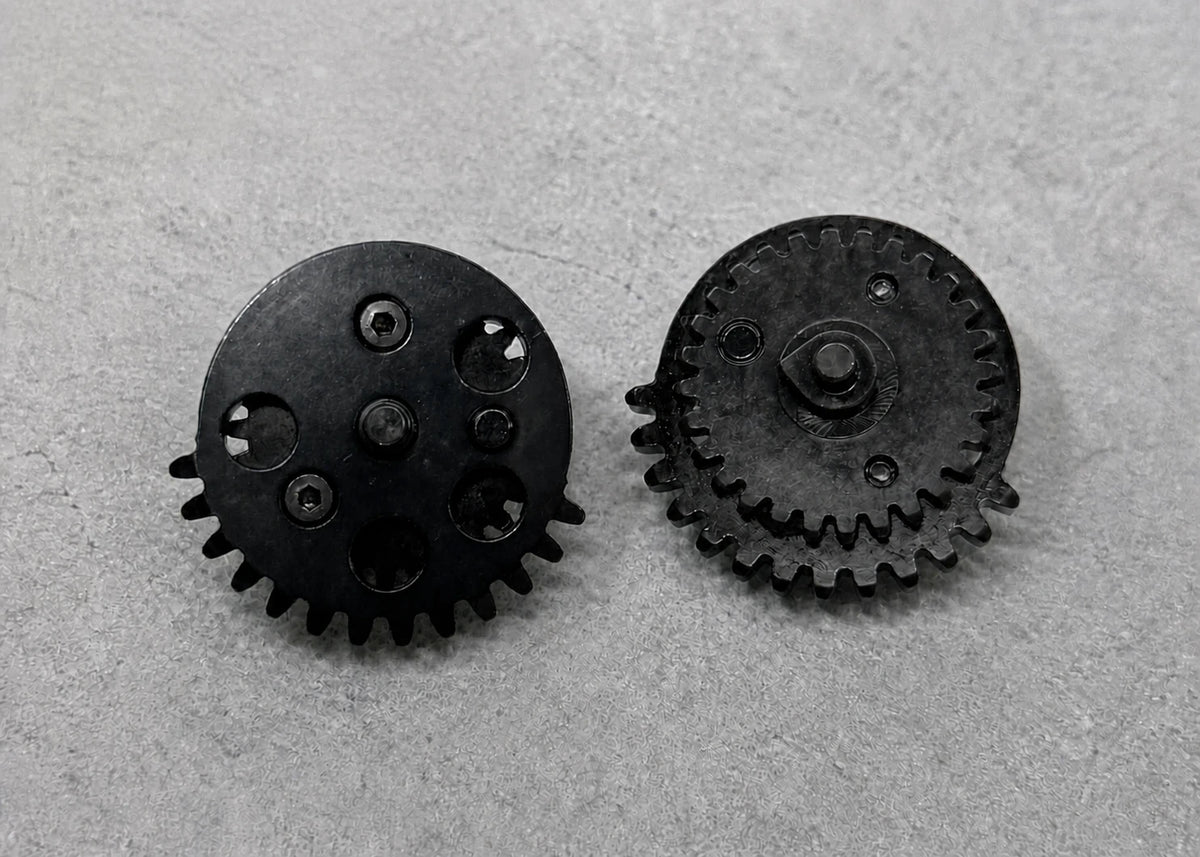
A standard configuration uses the piston travel intended for its matched gear and piston system. A short-stroked sector gear uses fewer active engagement teeth, releases the piston earlier and reduces piston travel and swept cylinder volume. Gear ratio remains a separate specification.
In a conventional SSG layout, 16 active piston-engagement teeth represent the standard stroke. A deliberately reduced active tooth count creates a short-stroke configuration, and the exact count depends on the matched gear, piston rack and intended build. The 13-tooth sector gear shown below is one example.
JVAN's SR25 AEG gear set uses a 19-tooth sector gear, while the traditional 18:1 set documented by JVAN uses a 16-tooth sector gear. Tooth count alone does not identify the ratio or establish fit in another gearbox.
The photograph includes a confirmed 13-tooth short-stroke SSG example; it does not establish gear ratio, platform fit, FPS, ROF or performance.
TAPPET, CUTOFF AND SENSOR
3. Timing and detection features
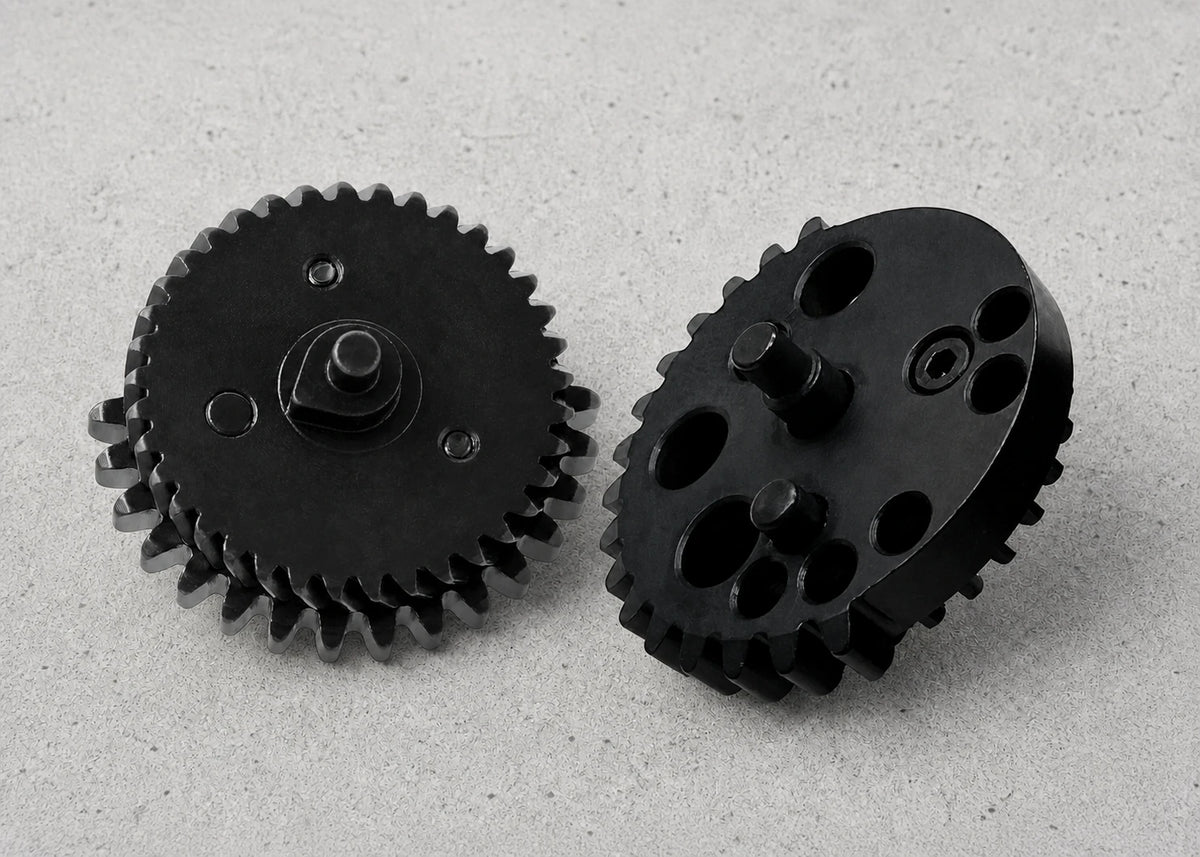
The tappet contact controls when the tappet plate and nozzle move, and its position and shape can vary by design. A mechanical trigger may use a cutoff cam and lever, while an electronic trigger unit can use optical sensing or a system-specific magnet.
JVAN uses the product terms New Tappet Plate Pin Position and Magnetic Control for specific product families. The exact tappet, magnet layout and control unit must still be confirmed before selection.
The reference image shows visible timing and control differences only; it does not establish exact magnet position, sensor method or control-unit compatibility.
CONFIGURATION OVERVIEW
Airsoft sector gear comparison
Use this table as a first filter, then compare the documentation for the complete gear set. Record the current gears, piston rack, gearbox shell and control system before removing parts.
One piston-engagement section per revolution.
Conventional single-stroke AEG cycle.
Match the complete gear set, piston rack, shell and axle support.
Two piston-engagement sections per revolution.
Purpose-built DSG setup.
Match the piston, spring, compression plan, tappet timing and control system.
16 active piston-engagement teeth in a conventional SSG layout
Full-travel configuration.
Match rack length, pickup, release and rear clearance.
In a conventional SSG layout, fewer than 16 active piston-engagement teeth; the exact count depends on the matched build
A build designed around reduced piston travel.
Match the piston rack, swept volume, spring system and timing.
19-tooth sector gear used in an SR25 AEG gear-set configuration
SR25 AEG platform.
Match the SR25 gearbox, complete three-gear set and piston engagement.
Uses design-specific mechanical or electronic timing features.
Matched tappet or trigger-control system.
Match tappet geometry, nozzle travel, cutoff lever or exact sensor method.
Use the table as a first filter
For replacement work, record the current gears, piston rack, gearbox shell and control system before removing parts. For a new build, decide the intended stroke and control method before choosing the sector gear.
BEFORE ORDERING
How to choose an airsoft sector gear
Start with the gearbox and the complete build rather than one visible label or tooth count.
Identify the gearbox and gear set
Confirm the exact platform, shell, axle diameter, bearing or bushing size, complete sector-spur-bevel set, piston rack, pickup, release and rear clearance.
Plan stroke and tappet movement
Identify standard engagement, a documented short-stroke layout or the SR25-specific 19-tooth sector gear. Check the tappet pin or cam, tappet plate, nozzle travel and return.
Confirm cycle control and ratio context
Match the mechanical cutoff, optical sensor, magnet or ETU requirement. Keep gear ratio choice separate from sector tooth layout.
CONTROLLED ASSEMBLY
Installation and build checks
Inspect mechanical movement and cycle control before treating the gearbox as ready for powered testing.
Set shimming and mesh
The closed shell should allow the matched gear train to turn without a hard spot.
Observe piston engagement
Look for clean pickup, rack tracking, rear clearance and release.
Observe tappet and control timing
The nozzle needs to retract and return, and the cutoff or sensor system needs to recognize the cycle.
Cycle safely before powered testing
Remove the magazine, disconnect the battery, clear the replica and wear eye protection. Open the gearbox only if you can control the stored spring energy. Close and secure the shell, rotate slowly through a full cycle and stop at any bind.
CONTINUE COMPARING
Related JVAN products and technical guides
Use the exact product specification and the supporting technical guides before confirming a build plan.
COMPLETE RANGE
JVAN airsoft gear sets
Compare available gear ratios, gearbox applications and product-specific details.
DSG PRODUCTS
Dual sector gear sets
Review products intended for carefully matched DSG-specific builds.
SR25
19-tooth sector gear set
View the documented JVAN SR25 AEG gear set with its 19-tooth sector gear.
TAPPET TIMING
New tappet plate pin position
View the JVAN 100:200 gear set with its documented tappet-plate pin configuration.
COMMON QUESTIONS
Airsoft sector gear FAQ
Short answers about SSG, DSG, short stroking and gearbox compatibility.
What is the difference between an SSG and a DSG sector gear?
An SSG has one piston-engagement section per revolution. A DSG has two. That structural change gives a DSG different piston-return and tappet-timing requirements, so the piston, tappet and surrounding system must be selected together.
Does short stroking change the gear ratio?
No. Gear ratio describes the reduction through the bevel, spur and sector gears. Short stroking changes the active piston travel. A build can use a named ratio and a short-stroke configuration at the same time.
Does a V2 or V3 label prove sector gear compatibility?
No. The shell, axle support, complete gear set, piston rack, tappet system and cutoff or sensor arrangement still need to match.